Find the AI changes worth making.
Detect waste, model the impact, decide with an owner, then verify the result against the same ledger and baseline.
Why Optimize
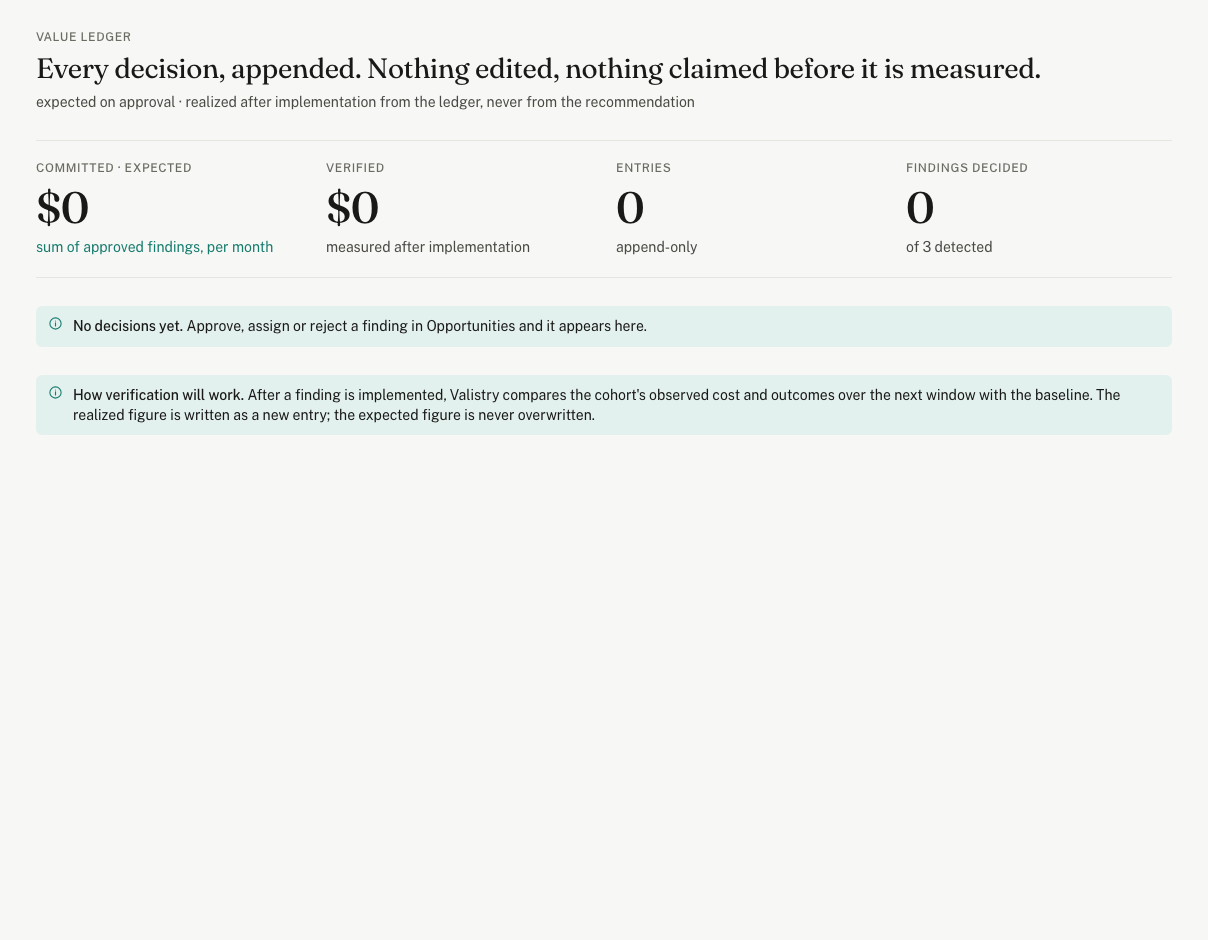
Expected savings are not realized savings.
A recommendation is not a decision. Every opportunity moves through one pipeline, against one baseline.
Identified
3 findings
Modeled
$2,944 / mo
Approved
1 · owner R. Mehta
Implemented
—
Verified
$0 realized
$2,944 per month
Prioritized by value
Finance sees what changed. Engineering sees the evidence behind it.
4 kinds, one queue
Beyond usage
Usage, architecture, commercial and operating-model changes are priced the same way and ranked in one queue.
$0 claimed early
Realized, not recommended
Nothing counts until it is measured against the baseline it was modeled on.
Every finding
Ranked by expected value. Honest about risk.
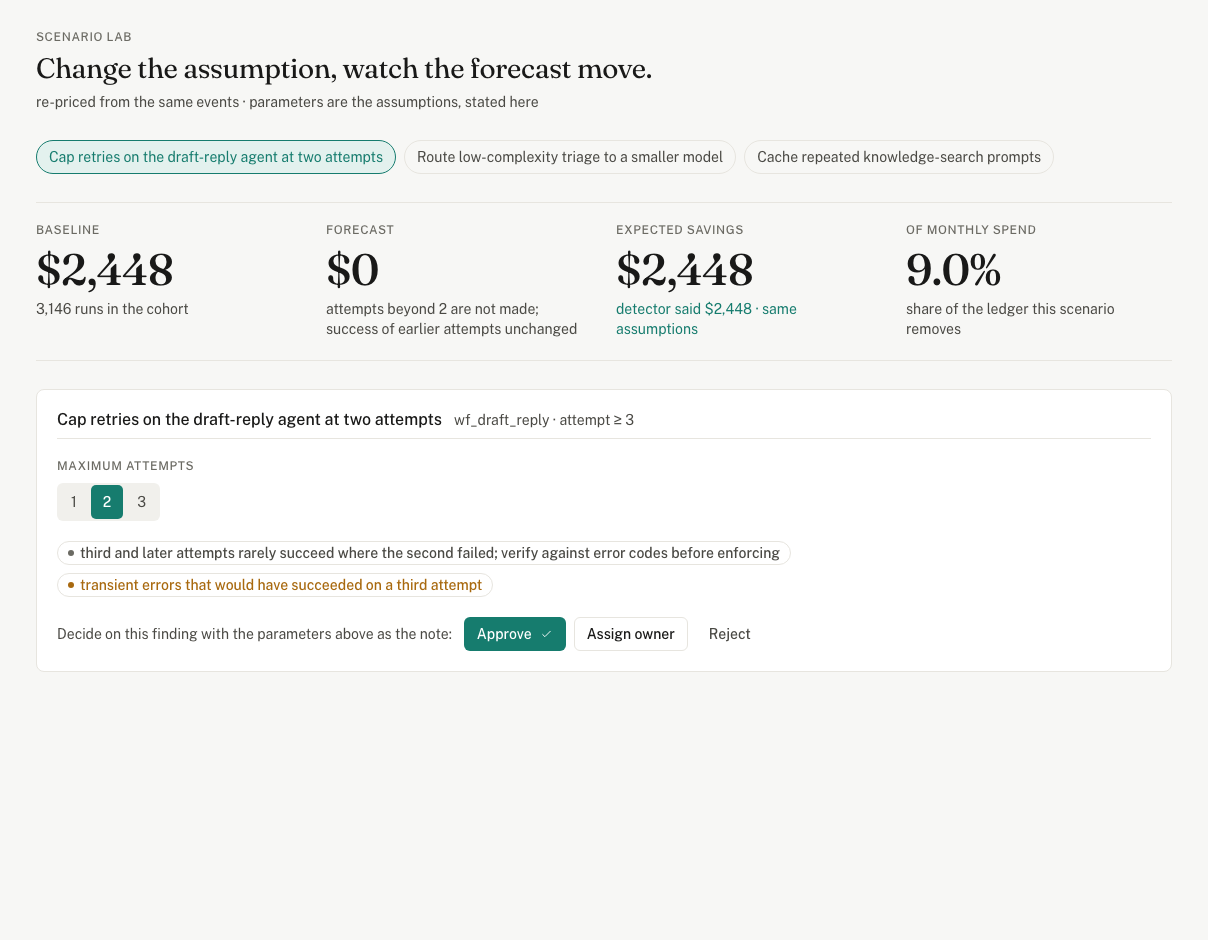
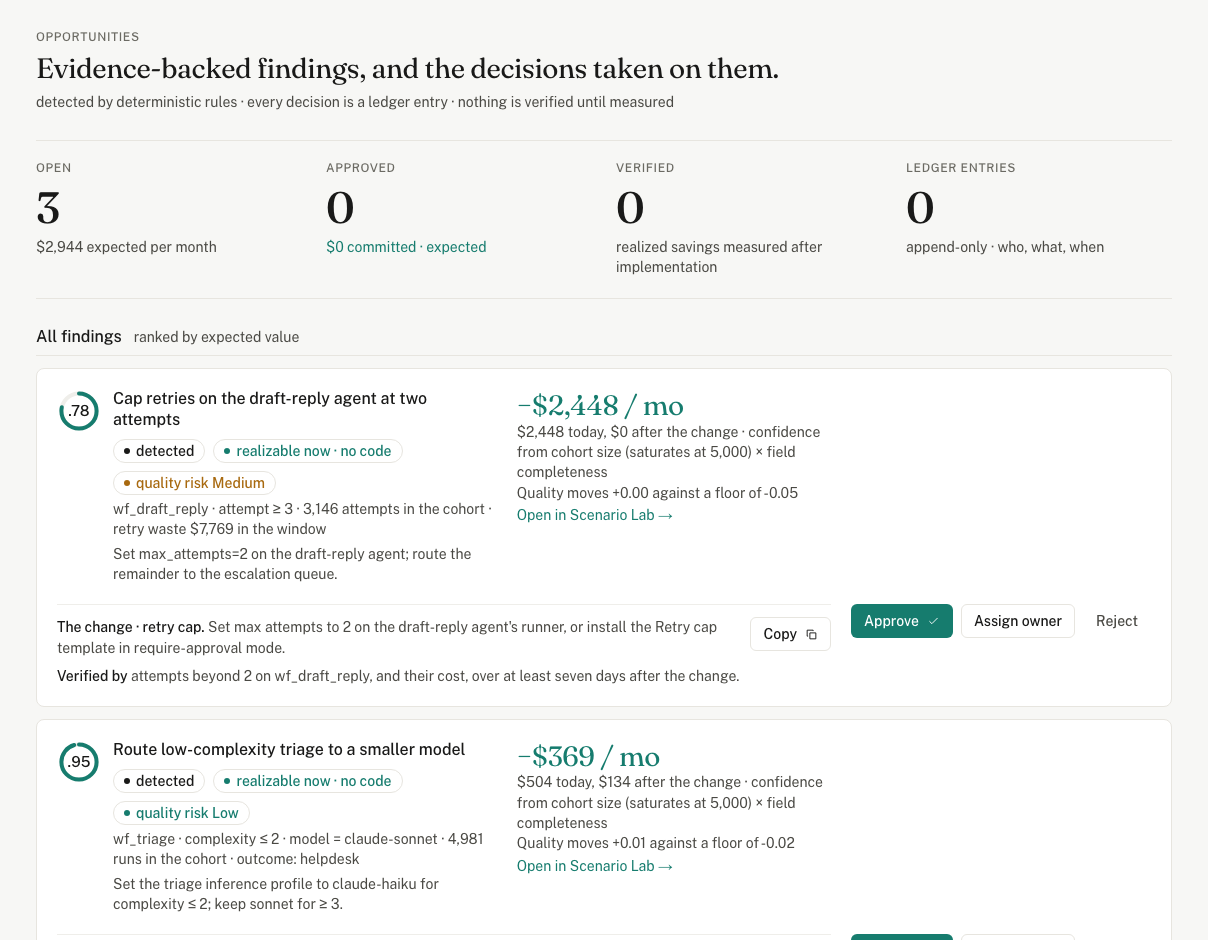
Three numbers on every opportunity: what it is worth, how sure we are, and what it might cost in quality.
Opportunities · open · sample org
3 findings · $2,944 / mo
| Finding | Change | Expected | Confidence | Quality risk |
|---|---|---|---|---|
Cap retries on the draft-reply agent at two attempts | Set max_attempts=2; route the remainder to escalation | −$2,448 | ||
Route low-complexity triage to a smaller model | Inference profile claude-haiku for complexity ≤ 2 | −$369 | ||
Cache repeated knowledge-search prompts | Enable prompt caching on the knowledge-search profile with a 24-hour life | −$126 |
How Optimize works
Three screens, one decision.
From a pattern in the ledger to a measured result, with the owner and the assumption on the record.
Spend less where it does not matter. Invest more where it does.
A 30-minute demo on your own estate, or connect one source and review your first opportunity.
Once a saving is verified, the next question is how to keep it from drifting back.
04Next: Control →