An owner and a reason for every dollar.
Map AI spend to teams, products, agents and customers. Then connect it to the outcome the workload was meant to produce.
Why Attribute
A shared account answers none of the three.
Who is responsible, what is it for, what did it produce? Attribute answers all three, for every dollar.
How coverage builds · each source of evidence adds to the last
One dollar, three answers
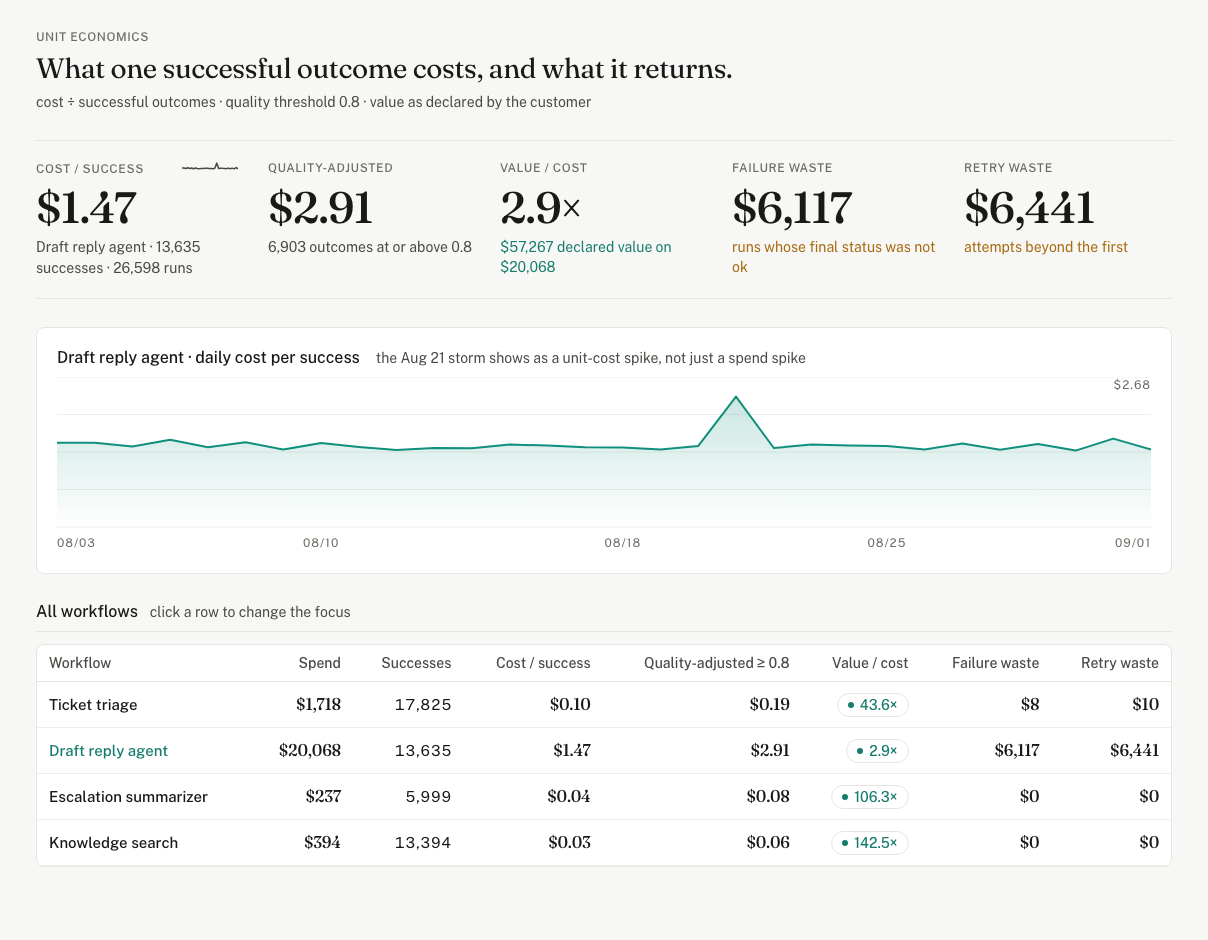
$20,068
Draft reply agent · 30 days
- R. Mehta · team_support_ai
- Draft reply workflow · observed
- $1.47 per resolved case
82.6% attributed
For finance
From a shared bill to an accountable portfolio, with a reconciled enterprise total.
$1.47 per resolved case
For technology
From usage to unit economics: cost per successful outcome, not token price alone.
0 estimates
Honest unknowns
An outcome on every dollar, or an unknown that stays visible until it is measured.
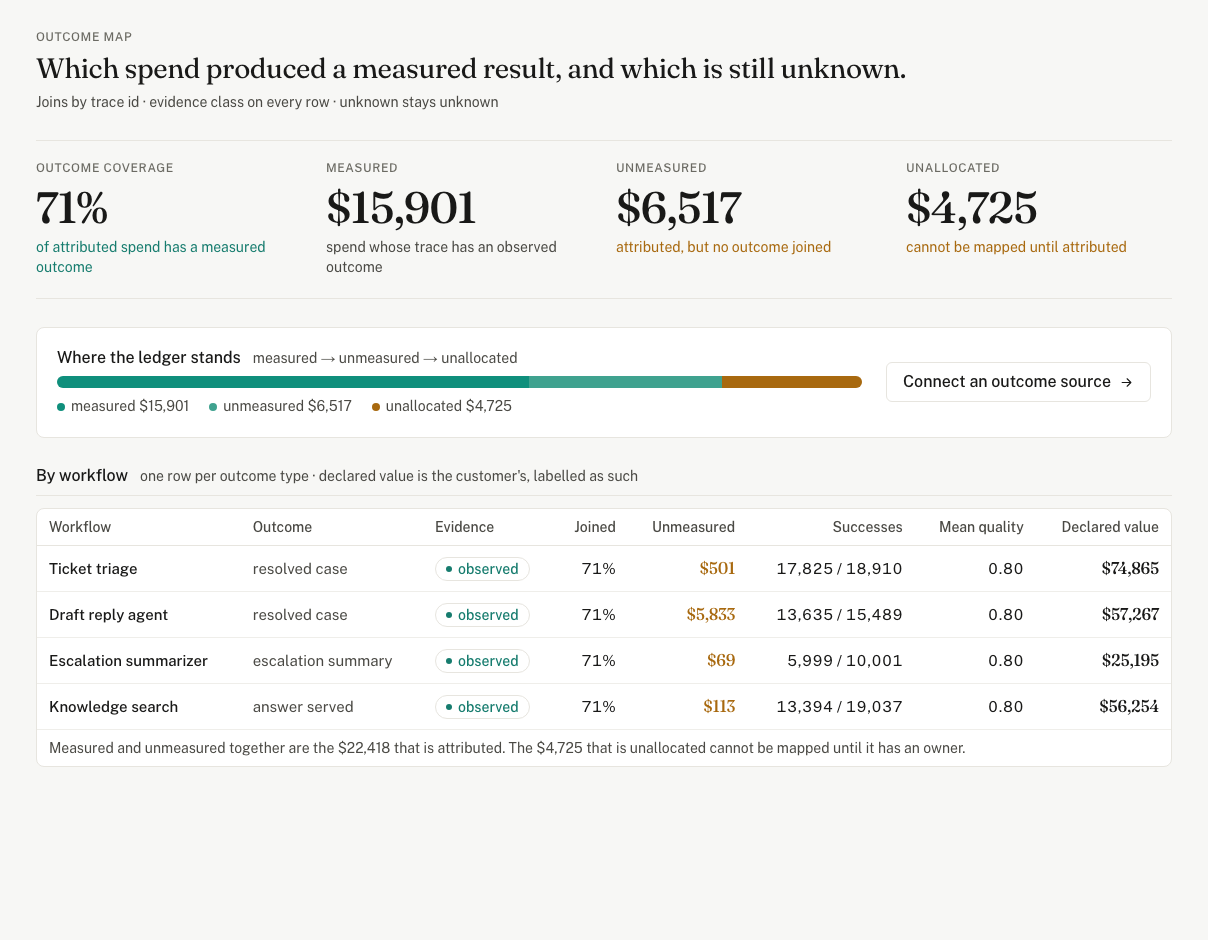
Where the ledger stands
Measured, unmeasured, or not yet allocated.
Every dollar is in exactly one of the three, and the row says which, so nobody mistakes a blind spot for a zero.
Ledger · 30 days · sample org
$27,144 total never changes
- 59%
A trace joined an outcome.
The run's trace id matches a business outcome, so the cost and the result sit on the same row.
- 24%
Owned, but no outcome yet.
The team and the workflow are known. No outcome source has been connected for this workload.
- 17%
Not yet attributed.
Carried as its own number with the evidence needed to allocate it. One published rule lifts it.
How Attribute works
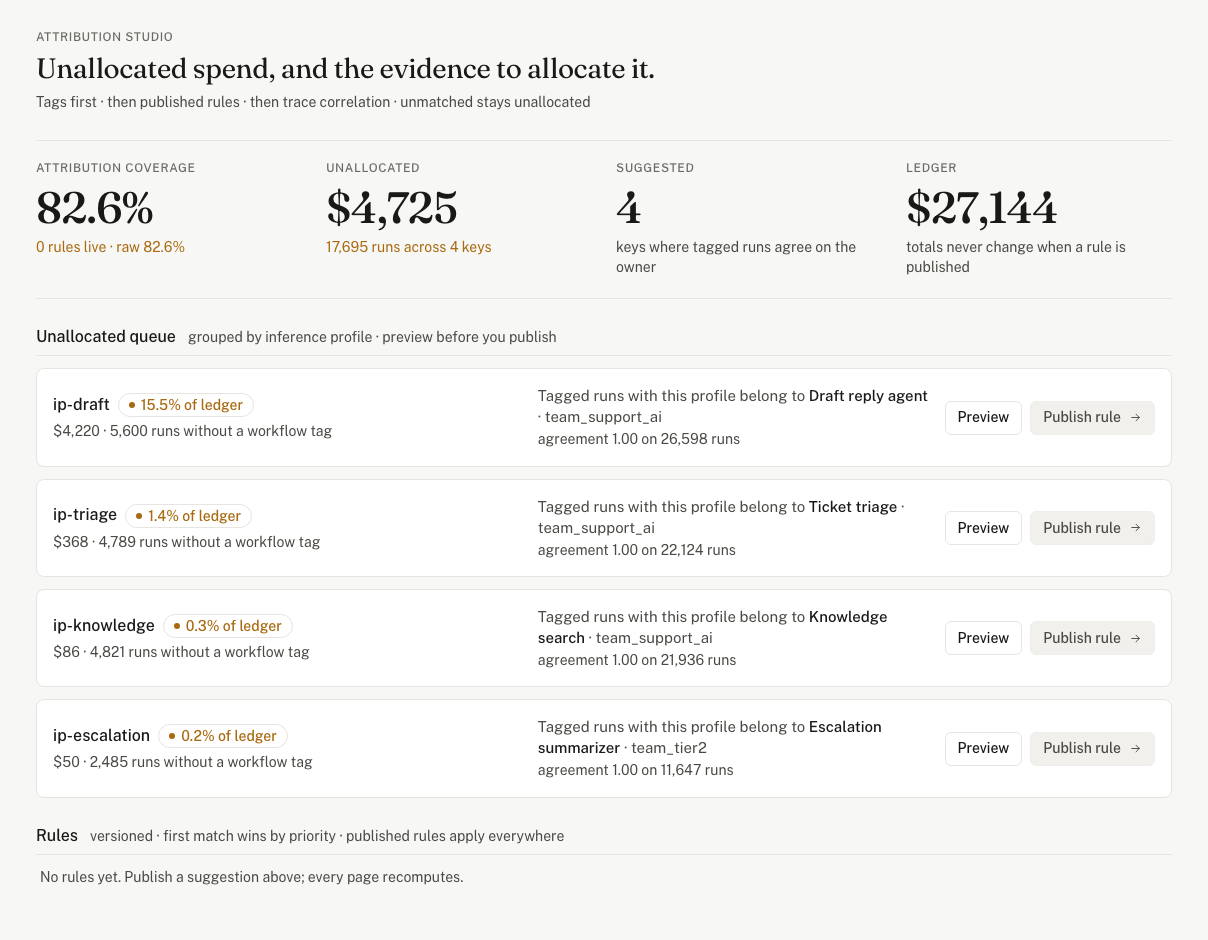
Three screens, three answers.
Who owns it, what it is for, and what one successful outcome costs, on the same reconciled total.
Cost becomes useful when it has an owner, a purpose and an outcome.
A 30-minute demo on your own estate, or connect one source and publish your first attribution rule.
Once every dollar has a name and a purpose, the next question is which changes are worth making.
03Next: Optimize →