Three steps, then every screen.
Connect a source, give every dollar an owner, realize a saving. Each step happens on one screen; each screen has a page here saying what it shows and how every figure on it is computed.
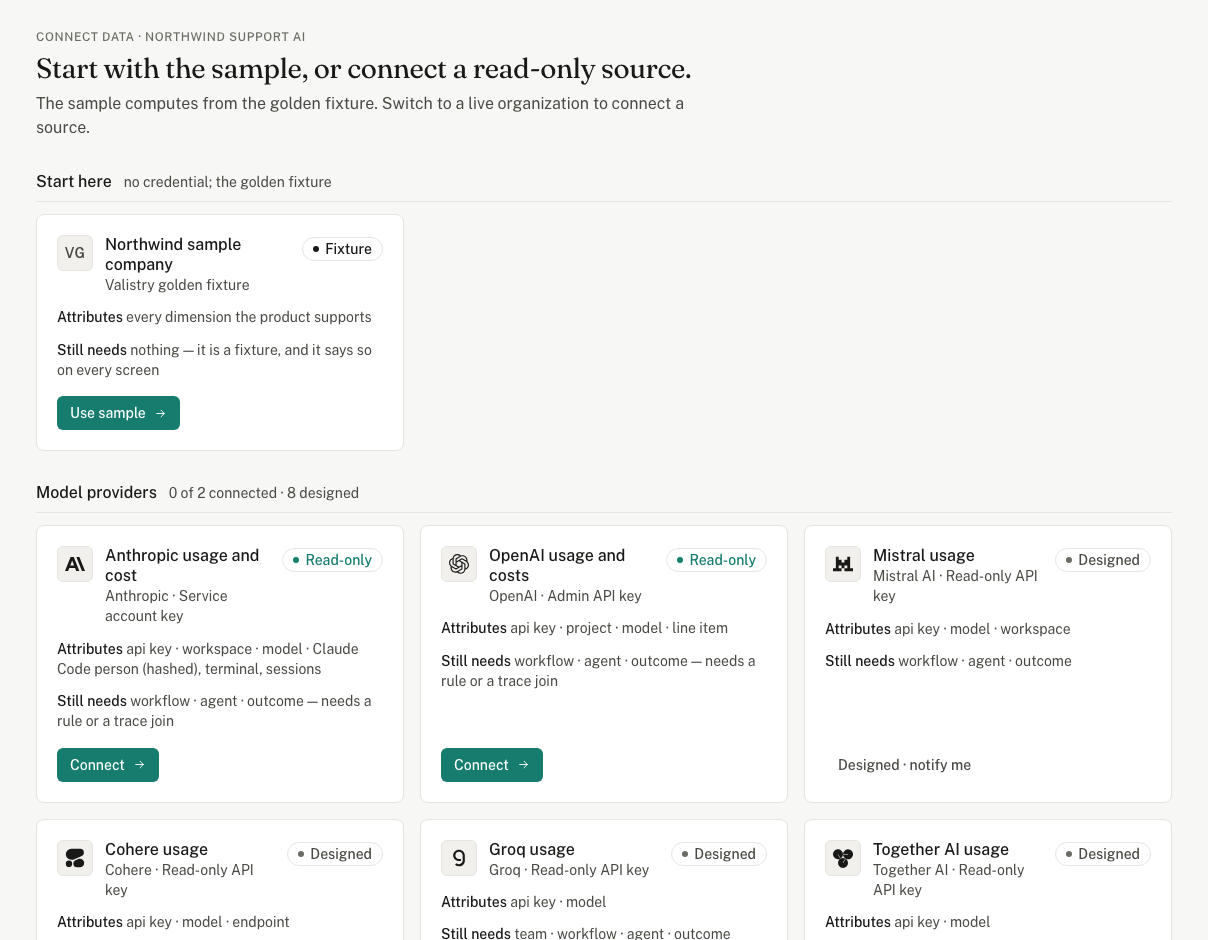
1. Connect a source
A read-only key or a sign-in on the vendor's page. The key is tested on seven days before it is stored; the first sync reads ninety and the scan arrives by mail. The screen →
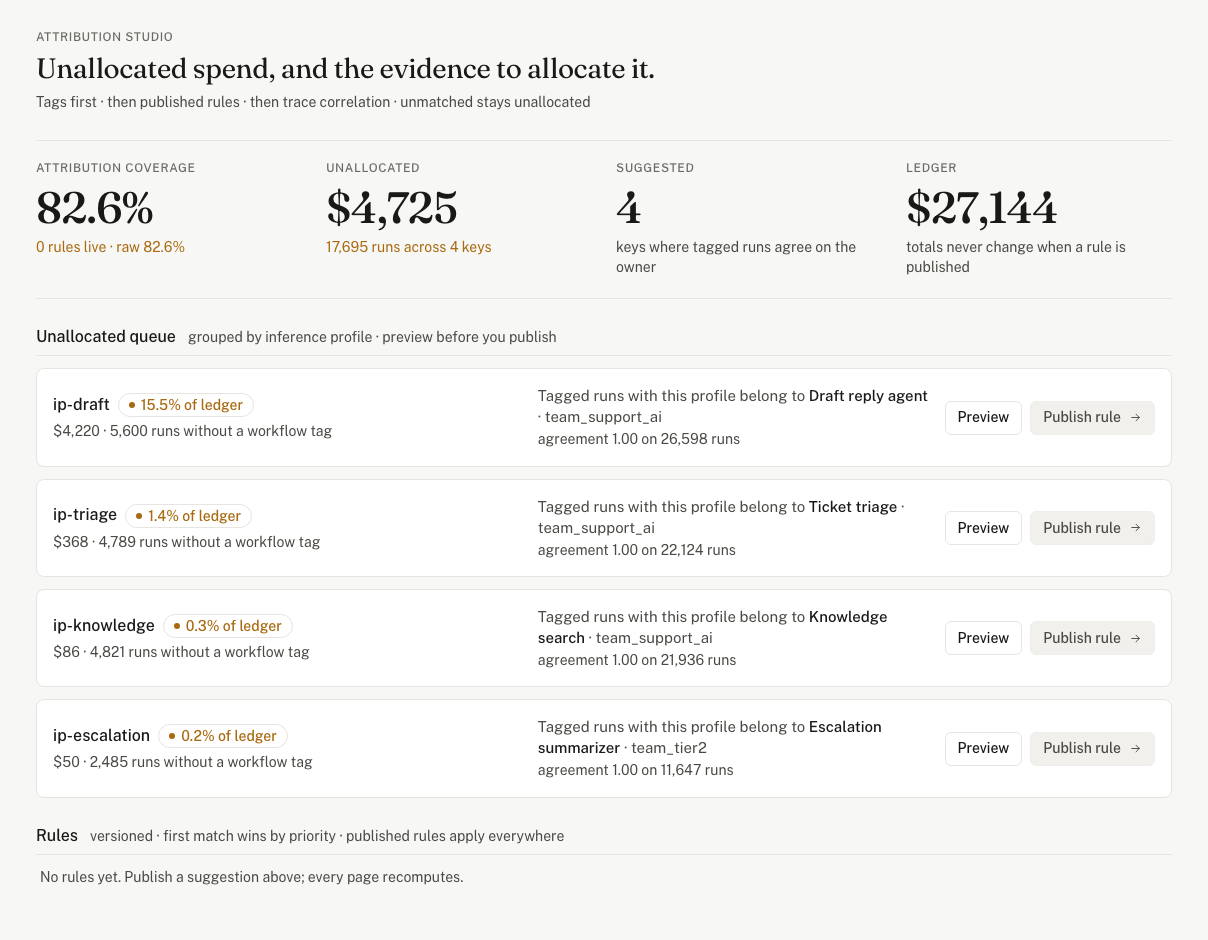
2. Give every dollar an owner
Unallocated is a named number. Attribution suggests rules from the evidence, previews the coverage each reaches, and publishes; every screen recomputes. The screen →
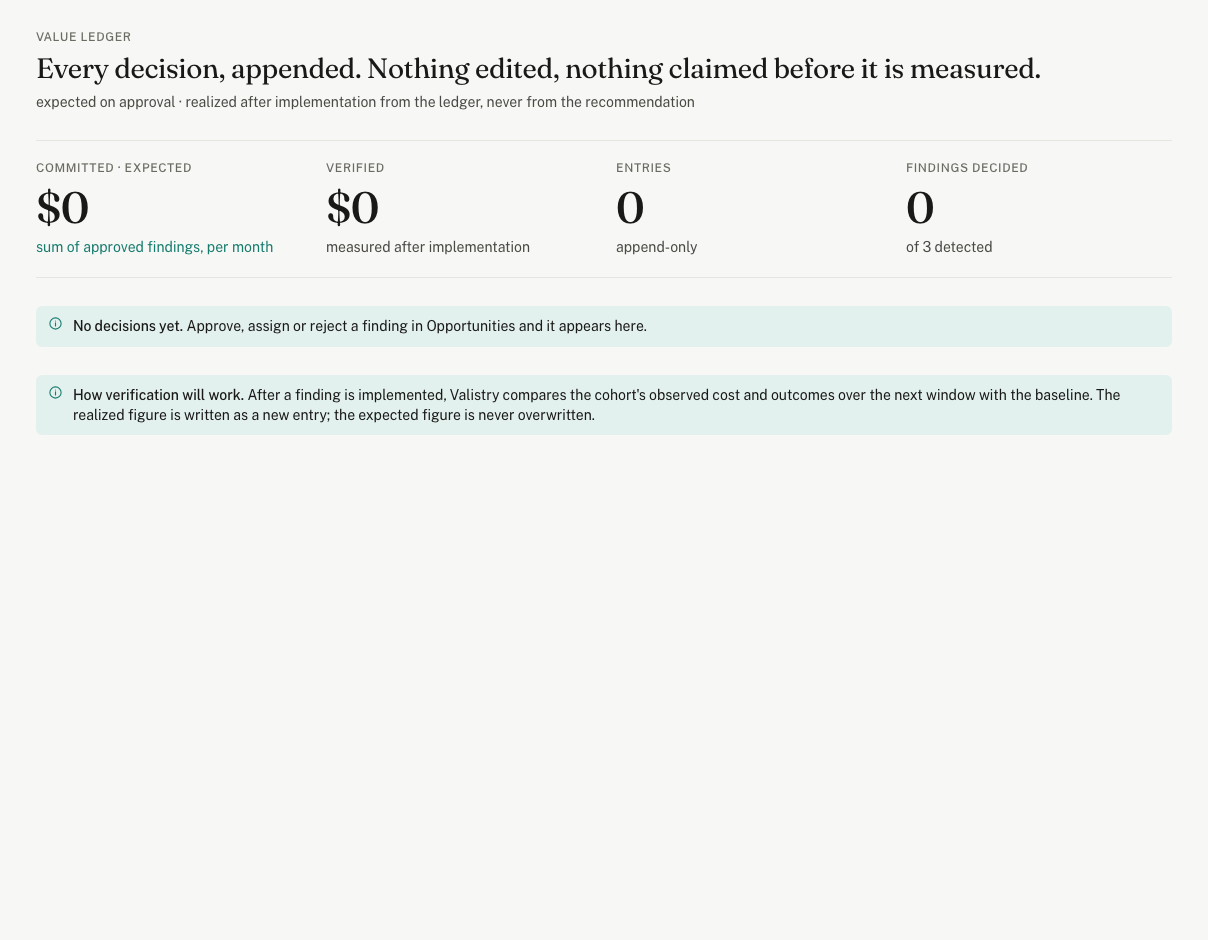
3. Realize a saving
A finding carries its evidence and the change to make. Approve it; the expected saving lands on the ledger, and the verified saving follows after seven days on the same baseline. The screen →
Every screen
- Overview
- The estate on one screen: the total, coverage, what is realizable now, the governed share, the day-by-day chart with the spike ringed, and the three findings worth most.
- Connect
- Every source, connected or not: what it reads, what it needs, and what the last sync found. A key is tested on seven days before it is stored, encrypted.
- Estate
- What is running and for what: every provider, model, workflow and agent, with its share, its owner or its gap.
- Spend
- The ledger by any dimension — provider, model, workflow, workload, team, agent, metering, status, day — with the change against the window before, both windows named.
- Attribution
- Where unallocated spend gets an owner: suggested rules from the evidence, a preview of the coverage each reaches, and every rule's history.
- Outcomes
- Spend against what it produced: each workflow with its outcome, joined by trace or by workflow, and its evidence class.
- Unit economics
- Cost per successful outcome, per workflow, with retry waste and failures kept apart from the successes.
- Opportunities
- Every finding the detectors raised, with its evidence, the change to make, how it is verified, and what was decided. Expected savings by kind, and every finding by state.
- Scenarios
- Change one assumption and watch the forecast move: the same runs re-priced on another model, a cache TTL, a retry cap, a seat count.
- Ledger
- Every decision on a finding: the saving expected on approval, the saving measured after the change, against the same baseline. Append-only.
- Agents
- Every agent with its business owner, its monthly envelope and its mode. A gap is named, never filled.
- Policies
- Templates with defaults from your own ledger, backtested on the window before a mode changes, and a ladder from observe to enforce.
- Approvals
- The held batch: runs waiting once a policy in Approve has breached, who decides, and the record of each decision.
- Alerts
- What the seven watches raised in the window, each with its severity, its cause and where it is decided; addressed or ignored with who and when; whether it was sent.
- AI P&L
- The report finance keeps: spend by team and workflow against the month before, coverage, realized savings, and the export — CSV and JSON from the same builder.
- Ask Valistry
- A question in plain words, answered with the figure, the plan that produced it and the rows behind it. The planner reads; the engine computes; a model narrates and never does arithmetic.
Reference
- The words
- Every term on a screen, in a mail or in an answer, defined the way a test could hold it.
- The record
- Every field one usage record holds, and the six things it never holds.
- Connectors
- For each source: what it reads, the access it needs, what it attributes on its own, what it cannot answer.
- The read API
- The same figures the screens show, as JSON, with the key or the sign-in the editor uses.
- llms.txt
- All of this as one text file, for an agent that reads before it signs in.